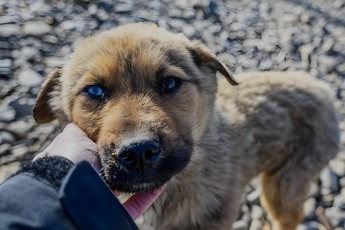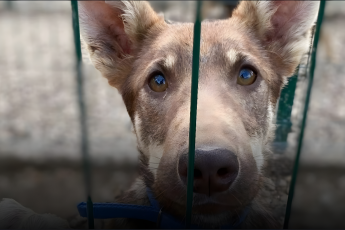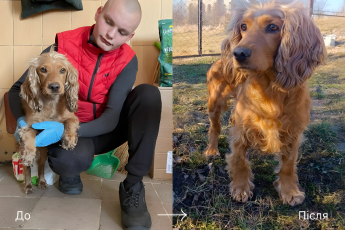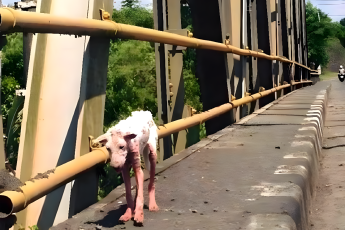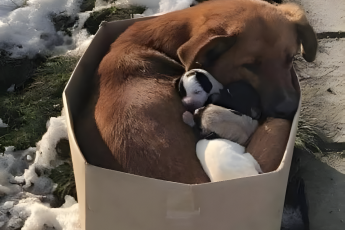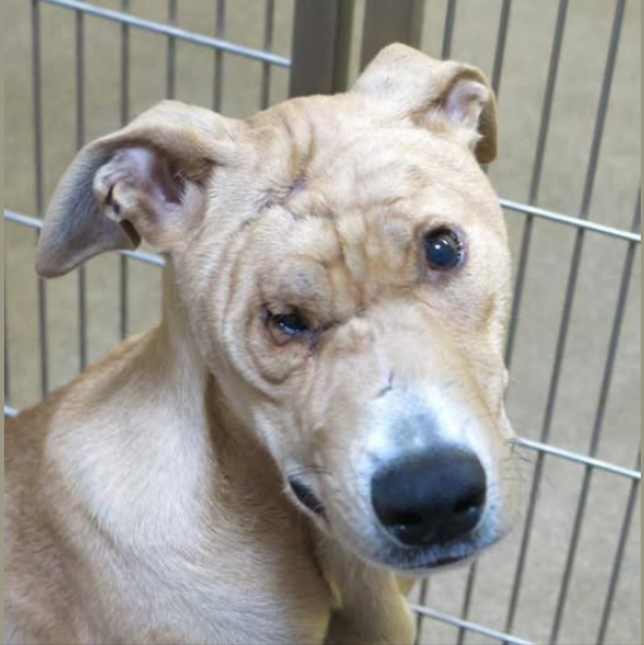
He was wedged into the angle where a crumbling wall met a rusted chain-link fence, a dog so thin it looked like winter had erased everything that wasn’t bone. A loop of wire bit into his neck. Ice rimmed his ears. Snow, the color of road salt, clung to his back. He didn’t look at us; his eyes were fixed on the pitted gray of the wall—the one place, maybe, that didn’t ask anything of him.
The storm rolled over our neighborhood the way alerts land on a phone: Blizzard warning. Whiteout conditions. Stay off the roads. But storms don’t check who’s alone.
The first to spot him was Svetlana from Building C—the neighbor who keeps dry cat food in her tote and latex gloves in her coat pocket, “just in case.” She posted in our group text with the kind of calm you use when speed matters more than punctuation:
Dog with wire around his neck by the garages. Won’t make it to morning.
Three of us reached him first: Pasha, Vika, and me. Wind funneled through the garages; the streetlight flickered; sleet stung our faces. The dog was a folded shape in the corner, like someone had collapsed mid-step and decided to stay small. Vika crouched—not grabbing, not crowding—and slid a thermal blanket under his ribs.
“Easy, buddy,” she said in the voice you save for scared kids. “We’re the warm team. I’m just going to sit here with you.”
Pasha worked a wire cutter into the knot by the rebar. A small click—not nearly loud enough for how much it released. I tucked a heated water bottle against the dog’s belly, our winter field trick.
“Hang on,” I whispered. “We’re going now. Warm’s coming.”
The car smelled like wet wool, rubber floor mats, and coffee from a travel mug. Red halos from the stoplights wobbled in the blown snow. Vika called the ER vet while we drove.
“Hypothermia, wire loop, severe malnutrition. Possible frostbite to ears and paws. Ten minutes out.”
On the other end, the only reply you want on nights like this:
“Copy. We’ll be ready.”
The animal hospital smelled like disinfectant and mint tea. Somewhere, a sterilizer hummed; the baseboard heat clicked and ticked. Dr. Halina had warm hands and a problem-solving gaze—the kind that never starts with blame. She palpated his chest, listened, checked reflexes.
“Hypothermia, cachexia, frostbite on the ear margins,” she said, voice level. “But his heart is steady. There’s a chance.”
In America, that sentence lands like a contract. Not comfort, exactly—a plan.
The first night he didn’t eat. We moistened his lips with electrolyte water. The team tucked him into a “warm capsule”—a hard-sided carrier lined with towels and heating pads where no draft can find you. Svetlana and I stayed. Not because we’re heroes; because going home to sleep feels like breaking an agreement when, three blocks away, someone is testing the world with slow breaths.
Near dawn he lifted his head—only an inch. It was enough. Outside, the storm kept shouldering the street. Inside, some small light clicked on.
On day three he took half a cup of chicken broth, cut with water. The broth came from Grandma Raya, the building’s unofficial mayor—the one who feeds sparrows, reminds the super about rock salt on the steps, knows every kid by name. She set a thermos on the counter and spoke like to a grandson:
“Eat up, champ. You look winter in the eye by keeping your strength.”
The name found him then: Blizzard. We said it out loud and it fit—the storm he’d outlasted. Names matter here. A name gets you a file, a chart, a place on a schedule. It gets you a voice when someone calls and says, “I’m checking on Blizzard.”
After that, the routine held us. Morning assessment. Midday IV fluids and the heat lamp. Evening ointments and bandage changes. Notes initialed on the chart. And every day, five quiet minutes of nothing but a hand behind one ear and soft nonsense in his good ear. The neighborhood chat kept humming: “Sent $25 on Venmo,” “I’ve got towels,” “I can cover the overnight,” “Picking up the Chewy order,” “Who can swing by Petco for more gauze?” Blizzard learned to accept kindness without dropping his gaze. That’s work too.
When the city finally exhaled after that first hard week of ice, we tried a test walk. Not a walk, really—three steps out the door, two steps back to warmth. Blizzard hugged the cinderblock. He parked himself by the bench where Grandma Raya tosses crumbs and stared into the brick as long as he needed. We crouched with him. No pep talks, no tugging. Eventually he shifted his weight one step away from the wall. One step is nothing. One step is everything.
We posted the adoption listing:
Blizzard, 2–3 years. Survived hypothermia and extreme malnutrition; now rebuilding. Temperament: quiet, gentle, cautious. Likes kids, tolerates cats. Startles at sudden noise, settles quickly with “his people.” Seeking a low-draft home, rug by a heater, humans who keep their promises. Adoption application, home check, patience required.
Replies poured in. “Can he live outside and guard?” No. “Birthday surprise for my daughter?” Also no. “Could we pick him up tomorrow?” That’s not how responsibility works. We weren’t shopping for applause—we were looking for a bond.
The message that fit came from Irene, a fifth-grade teacher in the next building. She has a nine-year-old, Danny, a quiet kid with neat notebooks and a habit of counting stairs. “We know what it’s like to fear doors,” her note read. “Our place is calm. If he’ll be better with us, we’re ready to go slow and together.”
We set the meet for Saturday. Danny arrived in a navy beanie with a tiny cube of cheese in his palm, “if it’s allowed.” It was. He sat sideways, rested the cube on his hand, and looked away so his eyes wouldn’t press. Blizzard sniffed, took it, and sat beside him without touching, like a careful line had been drawn between them and both agreed to respect it. Irene crouched, leveled her voice with his.
“In our home,” she said, “the blizzard stops at the door.”
Blizzard looked at her, then at her knee, and laid his head there. No fireworks, just a clean click: light on.
A cabbie who knows our rescue crates by sight took them home. The hallway smelled like lemon cleaner and vanilla cookies from five floors up. In the kitchen a small rug waited by the heater, two bowls, a folder of vet records, a jar of salve, and a bag of treats. Irene signed the adoption contract without fuss.
“Paperwork matters,” she said. “But the real promise is here.” She tapped her chest. “I choose you. Not once—every day.”
That night the wind found the antennas again and a gate in the courtyard clanged. Blizzard startled. Danny slid off his stool, sat on the rug, sideways, without staring.
“I’m here,” he said. “If you want, we can look at the wall together. I’ll stay.”
Blizzard breathed in the house—milk, cookies, clean laundry—and put his head on the boy’s knee. That’s how rituals are born, the ones stronger than weather: you share the forecast.
Life after storms smells like ordinary warmth. In the morning, the kettle sings. At noon, the package locker pings. In the evening, math worksheets spread across the table and a dog’s muzzle lands right on top. Blizzard still dislikes sudden bangs; he loves hand-boats—Danny’s hands cupped around one ear like a small harbor. He’s learning the floor plan: “window” means hear the city; “door” means only together; “kitchen” means settle.
The building is learning too. The woman on one, who grumbles about “snowy paws on the runner,” keeps leaving out wet wipes. Grandma Raya delivers beef liver wrapped in foil “for the brave.” The delivery driver sets packages on the windowsill now—“so the draft doesn’t hit him.” Blizzard watches all of it with the steady look of someone who’s seen enough empty to make a deliberate choice for people.
The scars remain: a pale band around his neck, neat winter “bites” on his ears. They aren’t sentences anymore; they’re commas in his biography. Sometimes Irene bends close and murmurs:
“You know, friend, our maps match now: where the wind used to live, there’s home.”
This isn’t a miracle story. It’s about people who didn’t scroll past: the neighbor who donated blood on Monday, the one who brought towels on Tuesday, the friend who paid for an IV on Wednesday, the sitter who came and sat in silence on Thursday, and the family who took responsibility on Friday. It’s about a vet for whom “there’s a chance” isn’t comfort—it’s a blueprint. A boy who isn’t loud but can hold a knee steady as long as it takes for a head to rest there for the first time. A winter that, when enough hands lift, ends in a square of kitchen light.
If you ever see a dog pressed to a wall like the world has narrowed to a single flat side, don’t yank, don’t shout. Get low. Slide in warmth. Call the people who know how to gather what’s broken. Say the one sentence that holds both accountability and shelter:
“I’m here.”
Sometimes the way back to life starts exactly there.