 A dog without sight taught a neighborhood how to travel by smell and sound — and how small, steady presences can restore names and directions we thought lost.
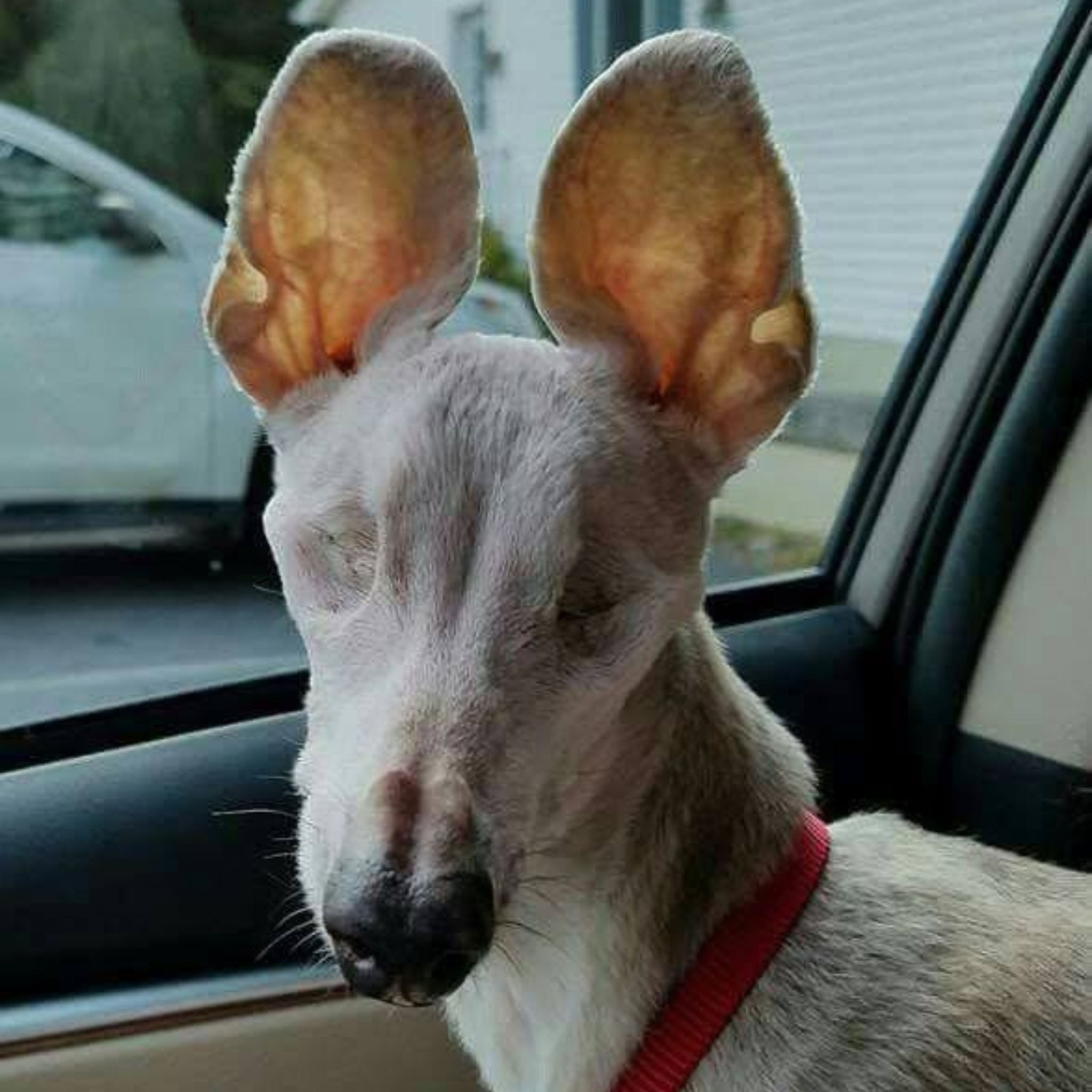
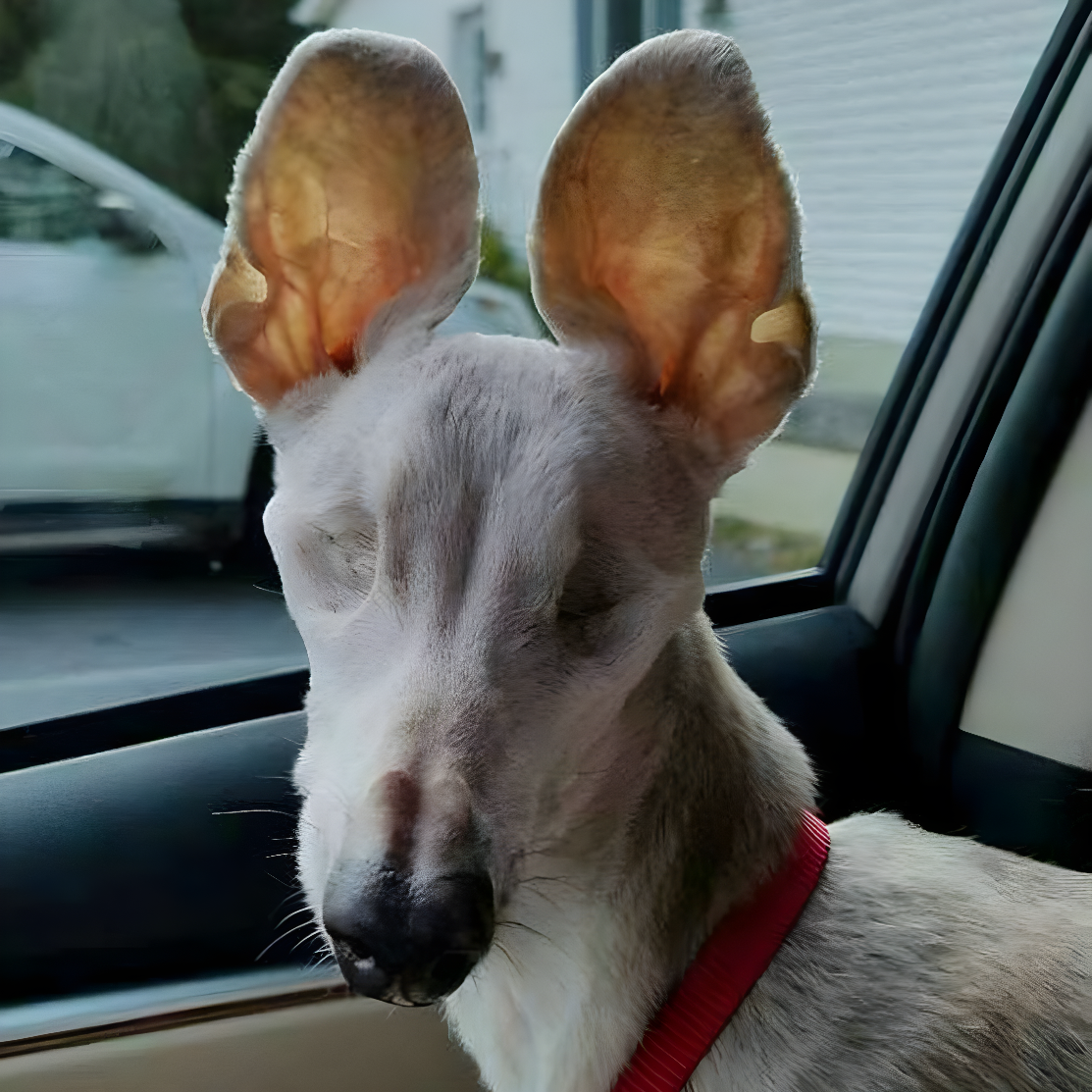
When I first saw her, she was crammed into the front seat among soft blankets and a bag of food that seemed inadequate, like an umbrella in a long rain. She wore a bright red collar and sat like a statue — no challenge, no fear, just a flat interior silence. Instead of eyes there were gentle folds of skin, neat as folded scarves someone stopped before they could finish a knot. It was not grotesque; it felt like the hush after the orchestra stops.
Her stillness was not absence — it was a different kind of attention.
The van smelled of old rags, tire shop grease and the sweet biscuits a volunteer keeps “just in case.” She turned at the sound of my movement, but did not scan; the tips of her long ears caught light like two amber panes. I said hello, though I understood the greeting would land somewhere other than sight. She exhaled the way people exhale before a trip. In that breath I felt ashamed for every time I’d labeled another being “miserable.”
We’d been called by a woman from the edge of the neighborhood: the dog had been sitting under her fence for three days, refusing to go. “She looks like she expects someone to put a leash on her,” the caller said, voice steady but thin. Neighbors offered guesses: some compared her to a greyhound, others muttered that she might be ill. When I buckled a harness around her, she stepped forward, tapped my hand with her nose, and seemed to say: “I’m here.” I answered on instinct: “Me too.” Lately I had been feeling otherwise.
At the shelter I simply called her “she” for days. Names are promises; I had learned to distrust new promises. Each morning she waited by the kitchen where the sound of cups and porridge guided her. She ate deliberately and listened keenly — the clash of spoons, the scuff of a slipper on wet tiles. If someone slipped, she would be the first to rise, as if she could sense a shift in the air toward light.
- Veterinary assessment: Rhythmical heart, healthy ears, stable breathing.
- Needs: dust control, ear-mite prevention, careful handling of strong odors.
- Advice: communicate with posture and tone; talk to her even without words.
The vet suspected she had been born this way: the scars were old and regular, as if her condition was part of her history rather than a fresh injury. The recommendation was less medical than relational — learn to “speak” to her with presence.
One evening an eight-year-old girl and her grandmother arrived. The child, Miroslava, walked with a small white cane and a patch across one eye; she has congenital glaucoma and was awaiting a second operation. Her grandmother, Valentina Grigorievna, talked us through their needs: a calm, medium-sized dog that would not pull and would teach her granddaughter to go outside more confidently.
When they entered, the girl immediately noticed the shelter’s mixed perfume — damp towels, kibble, the shy joy tucked into an unwashed bowl. “She” lay near the radiator, letting the warmth run over her ears. Miroslava, not looking directly yet seeming to land inside the room, asked: “What is she like?” I answered with an awkward metaphor: “Like the silence in a forest when you can hear the leaves fall.” Miroslava crouched, set her cane beside her, and asked if she could name the dog.
“Echo,” she offered. “Because if I call, she’ll answer. Her ears are like a word that comes back.” The name stuck immediately. Echo rose, approached, and pressed her forehead to the girl’s knee. Miroslava laughed, a bright, unexpected sound. Valentina wiped her eyes and relaxed for the first time in a while.
Evenings became their ritual. At dusk, when shadows gathered behind an old warehouse, Miroslava would arrive with her cane and Echo would wait by the gate, guided by the cadence of steps and the pitch of laughter. They walked as a pair: the child with partial sight and the dog with none, each becoming the other’s sensor. Echo read asphalt like a seafarer reads tides; she anticipated bicycles when they were still a whisper. Miroslava learned to name smells — fresh bread, gasoline, wet leaves, burnt sugar from the cotton candy stand — and I followed two steps behind, suddenly aware of how little our sighted eyes actually notice.
They became one another’s map: one mapped by sound and scent, the other by touch and rhythm.
Valentina asked if she could foster Echo. We explained care routines, drops, harness use; then I drove them home. In their hallway the world smelled of linoleum, fried onion and faint pharmacy notes. Echo surveyed the apartment, tapped along the bed’s edge and bowls, then settled her head on the grandmother’s knee as if to place a period on the day.
That night I worried about responsibility and whether I had romanticized a match. The next morning Miroslava sent a voice message full of glassy joy: Echo woke before her, waited for the cane, and stood quietly while Miroslava read product labels aloud as if they were stories: “buckwheat, sour cream, salt, cats” — the last one an explanation, not a grocery item, because the neighbor’s cat had peered in the window. Echo even finds her slippers; to the girl, slipper-smell is the scent of a lazy morning.
- Routine moments: waiting for the cane, standing at the gate, sharing breakfast.
- Unexpected skills: locating slippers, signaling oncoming bikes, sensing subtle human shifts.
At the clinic for a check-up, the vet marveled at Echo’s composure. Without lids she had no place to hide; yet she was quietly centered. “They often replace a lost sense with trust,” the vet said. I found myself talking: about my childhood fear of darkness, about a small bedside flashlight I keep, and how the wider world had gone dim and noisy lately — sirens, alarms and startling headlines. Working at the shelter had shifted from rescues to listening: to doors opening with fear, coughs mouthed in shame, an elder’s gratitude for a bag of food. Echo reminded me that one can move forward without scrutinizing every possible disaster; sometimes it is enough to be present for the creature who has chosen to trust you. That realization settled like a lid closing into place.
Spring arrived not by calendar but by laughter in the courtyard. Miroslava began to take her cane more often, and Echo learned to find the right entrance among the recurring smells of detergent and laundry. Then came an episode I keep like a jar of holiday compote.
At a busy market, Miroslava held Echo’s leash while Valentina picked greens. A woman paused, glanced at Echo and then at the girl. “Excuse me,” she said politely, “but why give a child a dog that can’t see? Wouldn’t it make more sense to have a seeing dog?” Before either of us could offer the usual defense, Miroslava replied calmly: “Sometimes the opposite is right. I thought I needed someone to see for me. Instead I needed someone who does not see and does not fear. When someone beside you doesn’t see and isn’t afraid, your fear shrinks until it has no name.” The woman bought dill and moved on. We stood there stunned. Valentina touched her granddaughter’s shoulder and whispered something warm and admiring.
That summer an online post circulated; a photo of Echo in the car was accompanied by a derisive caption. The mockery spread, then a man named Ilya wrote that he had laughed at the post but later watched Miroslava teach a neighborhood boy to identify the smell of motor oil and the creak of an old bicycle. The boy — Ilya’s son — had diabetes and was listless in the heat. Echo, lying in the shade, rose and nudged the child, whined softly and brought attention to a slipping sugar level. Within minutes the boy revived. Ilya apologized publicly and asked how to help with food and ear drops.
After that, Echo was invited to short visits at a school for visually impaired children. Their teacher, Anna Borisovna, said small miracles occurred every session. Children learned to “see” with smell and sound, to describe a world without pictures, to identify a cautious stair and the hollow tone of an empty can in the wind. They stopped hiding canes and bandages in backpacks; Echo’s steady presence made such conversations possible.
- Community impact: hypoglycemia alert, sensory lessons, emotional comfort.
- Therapy role: nonjudgmental companion, anchor in medical settings, bridge between children.
In autumn we returned to the clinic for Miroslava’s surgery. I drove them and tried to keep conversation light: stories about the shelter cats learning to open cabinets, new loaves at the bakery, the transit playlist where reggae seemed to have won over chanson. In the waiting corridor Echo lay at my feet, breathing a steady rhythm. In a magazine I read that animals often teach patience better than any course. The surgeon later reported the operation successful but warned of a delicate recovery — controlled light, quiet and careful monitoring. When Miroslava woke, still half in anesthesia, she whispered that she had felt Echo by her side as if a door inside had opened and the room beyond had grown less dark.
Sometimes presence is the surgery: a calm dog at the bedside, a hand on a knee, a steadying sound.
Unexpectedly, a young doctor recognized Echo. He told us that three years earlier a litter with severe eye defects had been found: some puppies went to homes, one pup with large ears had disappeared from records. Later a fourth-grade girl had arrived at his clinic carrying a thick package and a child’s note: “Please don’t scold. I left my stepfather and brought my dog Lily. She can’t see. Please find her a home. I’ll come back when I’m older.” Social services had taken the girl then, and the dog was moved; the trail ended. The doctor had never forgotten those ears. He later tracked down the social worker and, piece by piece, connected the history: the girl had grown, trained as a hairdresser, and volunteered at an animal aid point. She still kept a photo of the eyeless puppy. We wrote to her. She answered late that night, asking only if she might visit to stroke the dog she once left.
They met in the park on a Sunday. The woman, Nastya, approached shyly, as if stepping on thin ice. Echo heard her and extended her neck toward the small forgotten name, “Lily.” Everyone cried — even Valentina Grigorievna, who usually carries herself like someone holding a hot cup. Nastya sat, placed her hands over Echo’s ears, and the dog purred low and catlike, leaning her whole blind trust into the touch. Miroslava watched and smiled, as if she’d just understood something meant for older people.
Nastya did not reclaim Echo; the promise had been made to Miroslava. Instead she became a regular Sunday visitor, bringing chicken necks, telling stories of a new life, and saying thank you in small ways. Echo divided her “not-seeing” between two women: the one who once saved her and the one who made a permanent path home.
- Current life: Miroslava reads aloud, Valentina bakes and scolds the television, Nastya visits and volunteers.
- Echo’s role: leads by sound, anchors hospital rooms, teaches children to be unafraid.
I, for my part, removed the little flashlight from my bedside and gave it to a neighbor boy who could not sleep without a nightlight. I’ve learned to cross my own dark room without flipping a switch. Echo taught me to calibrate my hearing to the people who say “I’m here” without bright signals. At the end of any path — even those without windows — there is often someone with large warm ears who will hand back the name you lost. Sometimes they will call you by a new one; sometimes they will answer the old one and prove that memory strings can be rewoven even when we think they’ve burned away.
What matters is not the eyes we have, but the attention we offer.
Conclusion
Echo’s story shows how companionship can replace sight with steadiness, fear with trust, and how a single attentive presence rewrites paths for others. A blind dog became a guide, a classroom, and an instrument of healing: for a girl learning to navigate the world, for a family finding calm, for a neighborhood discovering unexpected resources. The simple acts — touching a forehead, waiting at a gate, nudging a stranger in need — taught more than any lecture. If you take anything away from this, let it be this: listen for the small confirmations of “I am here,” and let them lead you home.