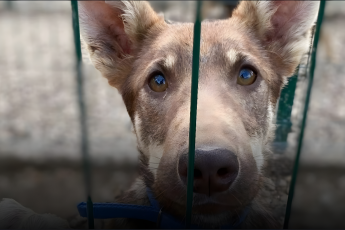
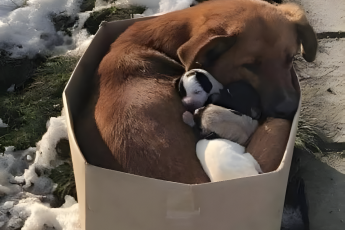
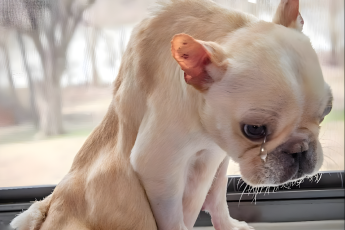
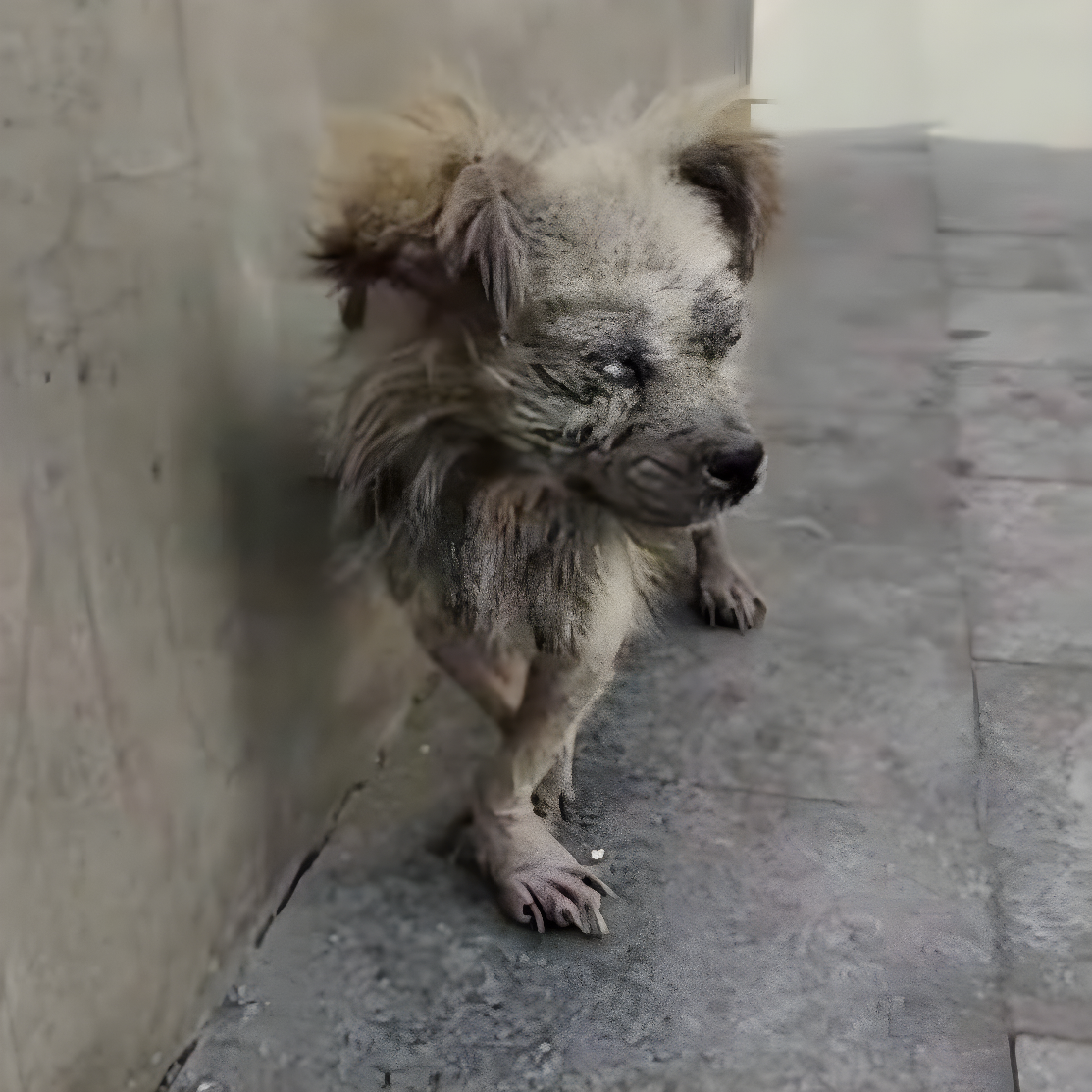
 I first encountered her at the frozen edge of a municipal shelter yard, where only volunteers and those with no other place go in winter. A thin metal run hammered under the wind; frost clung to the wire, and a dog was curled so still she looked carved from evening shadow. Her face was narrow, her eyes too large—devoid of anger, plea, or hope—only a patient kind of emptiness, the same look people wear at bus stops when they have stopped waiting for a bus but stand out of habit. A shaky marker on a cardboard box left at the market read: “Do not hurt. Silent.”
They told me she had been found tied to a fence near the market, trapped in a vegetable box in the dark when the lamps go out and no one notices who takes the scraps. There was a small tin tag on the kennel, a number hammered on like a surname that didn’t belong to her. Volunteers moved through the yard like commuters, nodding in passing. I hadn’t planned to be there; I only had a small bag of food, wipes, antiseptic, and a note from a friend—names scribbled for other dogs. This dog had no name.
Her silence was louder than any crying in that place.
I crouched and extended a hand through the wire. She was black-and-tan with a worn collar beginning to sink into her fur. She sniffed my palm with the caution of someone who has signed a contract and discovered the fine print is a lie. She inched forward, then froze at the metal. I waited for the wind to carry my scent—damp glove, road dust, home—so she could decide I wasn’t going to vanish. Her breath made the first sound I heard from her: not a bark or whine, but a tired exhale, like someone who’s walked a long way and finally stopped.
“Will you take anyone today?” the shelter guard asked, tugging his collar. I answered as if I were pulling a splinter out of my teeth: “I’ll see what I can do.” We were part of a quiet habit among volunteers—choosing the animals who don’t draw attention. The loud, cute, theatrical ones find homes quickly; the silent ones remain. Their quiet becomes a ticket with no seat: present, but nowhere to sit.
What I had in my pack:
- a small bag of dry food
- a packet of wet wipes
- a bottle of medicinal alcohol
She let me touch the tip of her nose. It was a tiny, cautious contact—verification that I existed. I named her Zosia on the way out, a small, almost accidental pet name that fit like a soft, unfamiliar glove. Her ears flicked as if the word landed there like a gentle stitch. We arranged a temporary foster and Oksana, a volunteer in a gray coat, called to check I really had room for one more bed and one more night walk.
At home she didn’t rush to explore. She went straight to the balcony door and sat, half listening as if someone very far away still called her name. Her old collar came off with layers of dirt; a pale band remained around her neck like an old mark. I washed it gently and she closed her eyes as if receiving morning rather than fingers.
She slept by the door, on watch—for a return she had been promised once before.
Two days later I went to the market to close the loop. I wanted to know who had left her and why. Stall noise, the smell of frying dough and old heaters—people shrugged: “There are many like that.” An old glove-seller said he’d seen two dogs initially; one vanished into the crowd, but this one stayed and waited until morning. She had been left with a promise that never came back. I bought gloves I didn’t need and carried the image home: the dog who kept a bargain with an absent voice.
Back at the shelter I brought supplies and Oksana admitted the list of animals marked “until spring” had grown. “Spring” was the word they used instead of an execution date—an attempt to soften the edge of what they couldn’t fix. Donations arrived in spoonfuls: three-liter jars of porridge, small sums for sterilization, the antibiotics that always ran out on the worst day.
A week later a woman and a small boy stood at my building’s entrance holding an empty leash. The boy’s eyes carried that same patient quiet. They had once found a dog at the market and called it Dymka, tried to keep it in a crowded room where pets were forbidden, and the dog had slipped away. The mother said they had left the dog with the market promise: “We’ll come back.” The boy, who couldn’t sleep without thinking she waited, sobbed silently. When I opened my door, Zosia rose and moved toward them in a way I had not seen. She met the boy and, with a tentative nudge, let him know she recognized something in him.
Choice, not ownership:
- I offered to foster her while they searched for housing that would allow a pet.
- They could visit every day; we would look for longer-term solutions together.
- If a real home opened for them, Zosia would go—but only if she chose them.
The boy fell to his knees and whispered “Hello.” The mother cried softly in relief. I realized then that Zosia belonged to someone not because of paper or time but because of a quiet thread—a promise spoken in the dark that still tied her to one household. Yet practical walls stood between them: eviction rules, communal room policies, an absent husband working elsewhere. I offered a compromise: the dog could live with me while they tried to find space; they could visit and gradually take part in care. I would keep the door open, not as a hero but as a steady presence.
“I will not disappear,” I told them. “I will keep the door ajar until you can.”
We settled into a fragile routine: morning walks for the three of us; the boy learning to hold a leash without jerking; the mother bringing a second-hand blanket. Zosia began to change—the cold patience in her posture softened. She stopped sleeping strictly at the threshold and occasionally came to lie near me, letting the air between us brush like a light touch. Veterinary visits showed the expected wounds: a scarred neck where a collar had embedded, inflamed eyes, dental wear, and a habit of freezing at loud coughs. In the waiting room she would nudge my fingers, checking I was still there.
After a month, a charity found the family a small one-room apartment on the outskirts. Officially the lease forbade animals, but the coordinator turned a blind eye: “Make it look like she isn’t there.” We moved as if smuggling light into a dim room—carrying a mat, a bowl, the cardboard note that had once said “Do not hurt. Silent.” I wanted to leave that line behind, but I also wanted the past to arrive with us so it could lose some of its power under a lamp.
When the boy saw his window light that first night, he darted between sill and door, standing like a guard who has been told his post finally matters. Zosia ran toward him with an unaccustomed urgency and they collided in the narrow corridor; both of them breathed fast, as if freed from a run. The mother placed a sprig of spruce on the sill like a small blessing. I stepped back, feeling a hot, complex relief—less pride than a softening, like a wound draining.
Small actions that mattered:
- We brought a worn rug to keep feet warm.
- I taught the boy how to clip the leash gently.
- The family kept me updated; I visited and helped when needed.
Before I left that night the mother handed me an old lower-door key on a dog-bone tag—an invitation to come and fetch Zosia for walks if they weren’t home. The object felt weighty not because of metal but because of trust. The key was the practical spring we had feared: not a goodbye but permission to enter. I continued to help—tea in glass cups, laughter about Zosia’s fear of kettle whistles, a softer collar. The boy learned to say his name aloud as if practicing a new language of belonging.
Over time Zosia’s watchfulness eased. She learned the sound of the apartment key and the boy’s footsteps around the corner. The market old-timer later saw us together and slid a pair of warm gloves to me with a half-smile: “You came back. Let her wait only for good things now.” I took them, and Zosia nudged my shoulder, as if to say, “Let’s go.”
We believed we were rescuing her, but she rescued us: she taught us how to wait together.
Conclusion: A neglected dog found by a volunteer in winter—a creature left in a box with a plea to be spared—became the hinge for a small human story. Naming her, fostering her, and then bridging her back to a family that had once left her produced far more than shelter and collar. It created steady presence, daily practice of patience, and the realization that compassion is enacted through time and repeated small acts. Practical barriers—regulations, money, crowded rooms—did not simply disappear; they were negotiated, softened by persistence, and by a promise kept: to stay until someone could truly arrive.
Key takeaways:
- Quiet animals often need the longest time to be noticed and loved.
- Fostering can bridge gaps between policy and real lives.
- Small, repeatable commitments—visits, walks, paperwork—change outcomes.
When we walk now—the boy, the dog, and me—neighbors sometimes look toward us and say “family” in passing. The word no longer makes me flinch. It finally sounds like the key did: permission to open, to enter, and to stay.