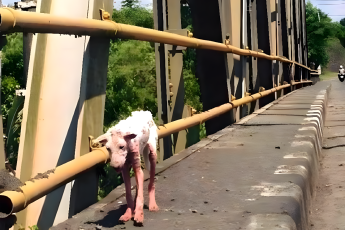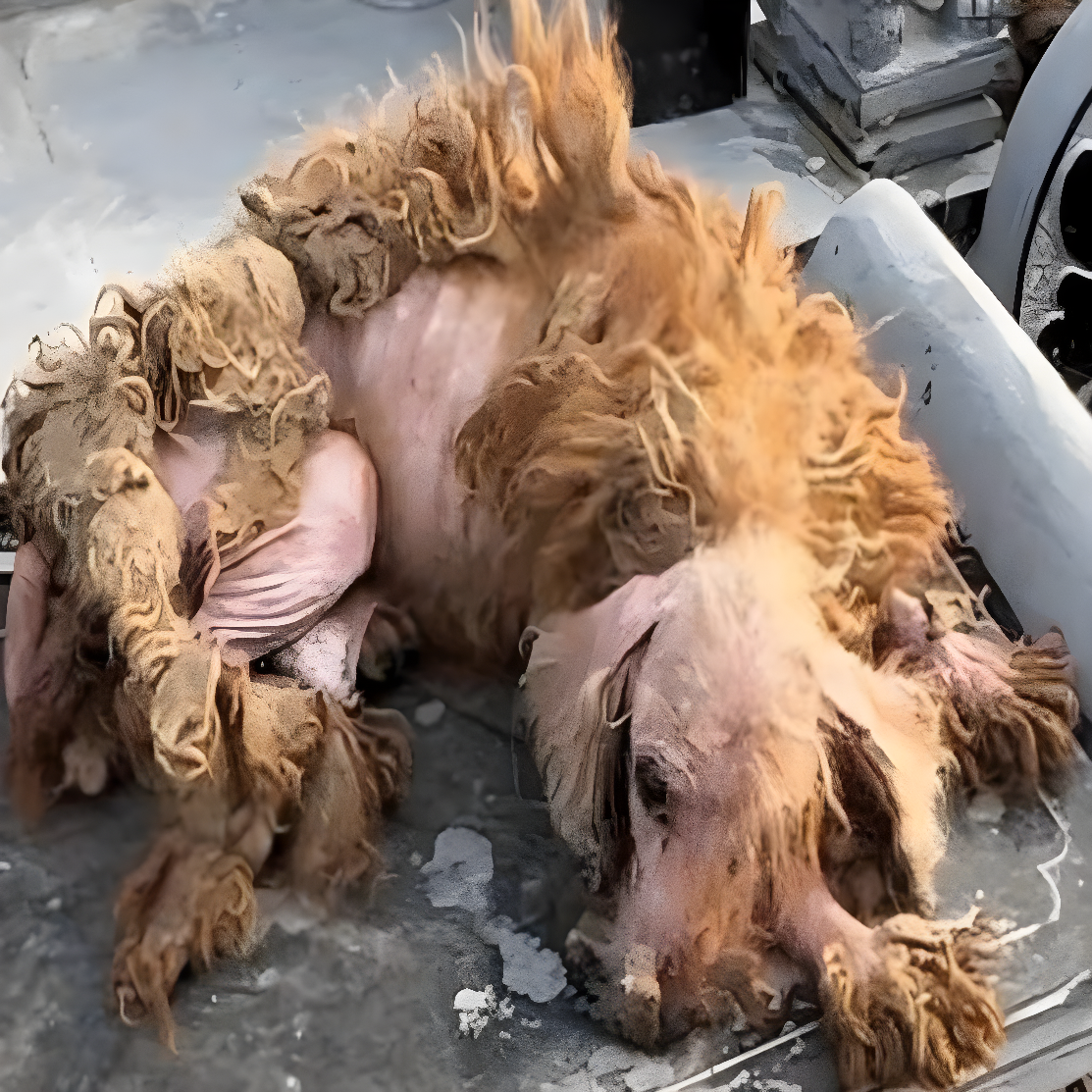
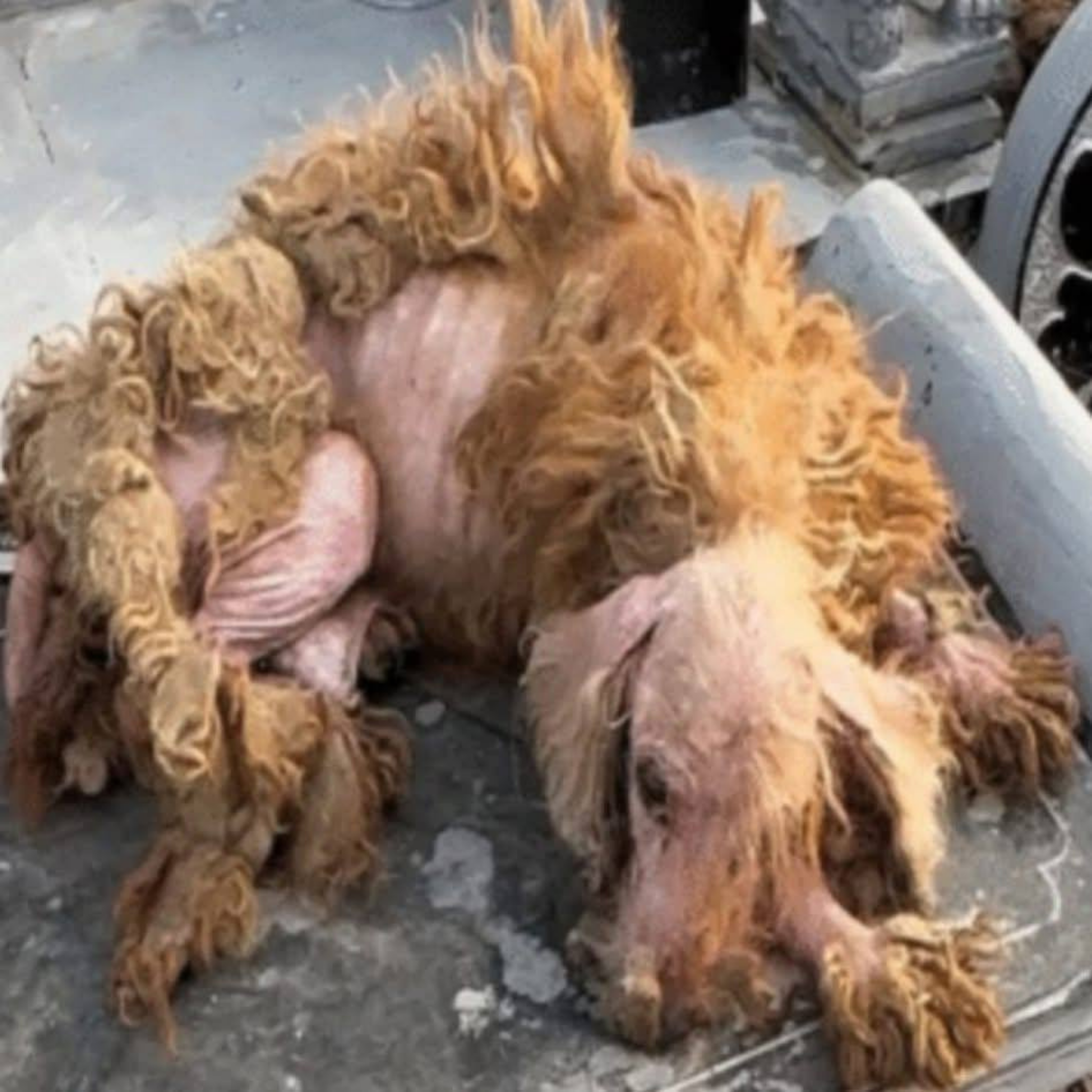
I found him on the flat roof of a market no one climbed for pleasure: the ladder wobbled and the air tasted of rust and stories left in canvas stalls. He lay curled on a concrete slab, paws tucked like someone guarding memories; tangles of red fur had hardened into crusty mats, skin exposed pale and raw beneath, and a cheap cord had left a tight ring at his neck. His eyes were unusually dark and old, tracking my hands with the quiet of a creature that has learned the rules too early and simply waits for the moment to leave the game.
I set my jacket beside him to block the wind, whispered a human name — Sam — and saw his ears barely stir, as if the sound fit into a memory he couldn’t afford to lose. The place was too exposed to leave him there, so I slid a folded T-shirt under his belly with slow, deliberate motions and lifted him, though I’d stopped believing I could carry anything heavier than my own day. From the stairwell a caretaker from the neighboring yard peered out — the sort of man who prefers order to discussion — and offered the usual, rehearsed counsel:
“Don’t risk it — call animal control. They’ll take him, process the paperwork, and you won’t have to bear the responsibility.”
I answered that I would contact a veterinarian, not the catch-and-hold service, because forms can turn blind and Sam’s eyes were the only mirror keeping me human.
He shrugged, lingered a moment, then descended. I carried Sam through back alleys and avoided busy streets; every step stretched farther than the last because other people’s suffering lengthens distance. Inside the clinic the fluorescent light and bleach smell left no room for excuses. The receptionist glanced up at my hands, at the crumpled shirt, and then at Sam, and said with level honesty:
“We can start now, but the care will be complex and costly. It will demand time, patience, and someone who won’t disappear in a few days.”
“Put everything on me,” I said. “Tell me plainly what to do so I don’t make a show of good intentions.”
The veterinarian, lean and practiced, examined Sam the way a craftsman inspects a worn board — precise, unsentimental. She traced ears and skin and separated the mats with fingers that moved as if learning patience from the animal itself. Her verdict was steady and strangely calming:
“This is long-term neglect: severely matted coat, tethered, and underfed. We’ll remove the mats gradually, run bloodwork, start IV fluids, pain relief, and antibiotics. Tomorrow we’ll begin combing, but today he needs to know someone will stay.”
“I’ll stay. Tell me where to sit so I’m useful instead of in the way.”
Sam lay quiet, not relaxed but emptied — like cracked clay that retains shape only because there is nowhere left to go. I listened to the drip of fluids and spoke out the one confession that had been stacking inside me: I work in a small woodworking shop nearby where mornings smell of shavings and hot tea; I fix things others discard because wood, if treated with care, can survive a fracture. A year earlier I’d lost a dog — Spunt — through absence and promises broken by shift work. Since then I had feared bringing anything living close enough to break my heart again. I told Sam I could not guarantee heroics, only presence, and that I would not leave him halfway through.
When I finished, he exhaled a small breath that felt like someone finally being heard.
The next morning I arrived before the clinic opened with a cheap comb and dull kitchen scissors, more from willingness than skill. The vet accepted my humble tools with a wry smile, handed me gloves, and demonstrated how to split heavy mats into narrow layers so the skin beneath could breathe.
Through the glass a man in a dark municipal jacket entered: calm, official, carrying a folder. He spoke with the practiced neutrality of someone trained to end messy conversations:
“We received reports of a neglected animal and inadequate care. Protocol requires seizure and placement in an isolation facility.”
The vet replied in the same measured tone: Sam is medicated and unstable for transport; there are records and a treatment plan, and sometimes the right procedure is not the literal rule but the humane choice. The officer paused, looked at Sam and then at me, and for the first time the edges of his official script softened; he nodded as if something small inside him had shifted.
We spent the day unpicking fur that had become like compacted husks. Clumps of hair collected on the table, heavy and damp with dust and the metallic tang of old chain or fear. Beneath the mats the skin revealed itself tender and surprisingly like new timber. Old cuts, rope abrasions, the map of a hard life appeared; Sam bore it without fury. If I accidentally touched a raw spot, he looked up and seemed to say: keep going, I will hold on, don’t stop halfway.
By evening he was physically lighter, but more importantly, a layer of endurance that had demanded he “endure” was gone. He no longer carried that single commanded word like a stone.
Small acts matter:
- Slow grooming restores skin and trust
- Consistent presence matters more than grand gestures
- Community attention can bend bureaucracy toward care
On day three a woman from the market — Irina, who sells spices and measures her words like weights — watched Sam through the clinic window. She later told me, quietly, that Sam had been kept tethered at a nearby warehouse, groomed with kitchen scissors, and neglected when the owner’s drinking worsened.
Her account filled in the outline of his past: bought for status, kept on a short rope, fed from leftovers, and eventually abandoned as debts and new companions took precedence. An official once rang the bell and left a note that served more as a polite excuse than intervention; nights passed and the dog kept faith with a place long after people had stopped caring.
Later that week a ten-year-old boy approached the clinic gate holding a battered plastic collar. On its inside, in a child’s felt-tip scrawl, someone had written a single word: Home. He explained he had lived in the warehouse and had tried to sneak water to the dog until reprimands stopped him. He offered the collar now, trembling with the seriousness of a child making an adult choice.
That small label — a childish attempt at ownership — became the talisman for everything we were doing. I held the plastic strip like a weathered postcard and realized our aim: to make a single childish claim true.
By the second week the vet cleared Sam for release under a strict aftercare regimen: gentle baths, topical ointments, a soft bed, gradual walks, and above all, no shouting. I carried him up the narrow steps to my workshop’s tiny loft — a cramped room with a narrow window and a table littered with pencils. There was a smell of fresh shavings everywhere, the lightweight kind that settles in your palm without pricking. Sam circled once, lay near the bed and rested his head as if fearing to crush the air. He slept without the startle that had punctuated nights for months. I sat on the floor and listened to his breathing; outside, the first drops slid from a metal gutter in patient taps. For the first time in a long while I believed that wrongs might not be undone but could be properly survived.
Days later the municipal officer returned different: sweater instead of jacket, voice less a blunt instrument. He told me he’d corrected paperwork and requested a temporary guardianship note, promising to mark in his report that the dog had a caretaker and a home. It was an administrative kindness that felt like a risk, but also like a human decision passing through a system.
Volunteers appeared in small, steady ways. A machinist with a long scar signed up for overnight shifts. Colleagues at the shop chipped in small sums and a long strap that would serve as a leash. Irina brought a jar of turmeric and a small envelope of coins “from customers who care.” The world nudged forward in tiny increments.
Then, one afternoon, a man with grey at the temples and a worn coat came to the clinic and asked for “the carpenter with the dog.” He was the former warehouse owner. He did not come to ask forgiveness in neat words but to offer concrete help: keys to a small shed, a promise to build a weatherproof enclosure for winter, and to contribute to veterinary costs while he relearned steadiness.
We agreed cautiously; he proved true. Within a week he carried boards and a lamp, drove nails, and set a hook on the door. The crucial change was not a public statement but the steady hand that returned to do the work. Before the first snow we stood together — me, the boy with the collar, and the man who had once been indifferent — beside a small wooden shelter warmed by a single bulb. Sam approached, sniffed the new air, bumped my palm, and then entered the shed as though claiming residence rather than confinement.
The boy sat on the threshold and said, in the brave tone of a child who has grown a little: “I was scared to speak up before, but now I’m glad we made him a home together. It’s easier in three than alone.”
What this case taught us:
- Rescue is a process, not a single event
- Community, even when small, sustains recovery
- Administrative systems can bend toward care when people take modest risks
That night, back in my loft, Sam laid his head on my foot and slept. I cried quietly, not out of pity, but from a lightness that hope sometimes sets on the bones to remind you you are still alive. Outside the first snow hissed on the boards, and the air smelled of pine shavings warmed by the heater. There would be pills, ointments, bills, and weariness ahead — inevitable tests of patience — but they were no longer the point. The point was simple: light, warm shavings on the floor, a lamp that doesn’t sting the eyes, and a dog who breathes evenly because the word Home, written in a child’s uneven hand on a plastic collar, became more than ink: it became action.
Conclusion: A neglected animal’s rescue often begins with a single attentive act and grows through steady, patient commitments. Medical care heals the body, but recovery requires presence, community cooperation, and administrative compassion. In Sam’s case, small, consistent efforts—gentle veterinary treatment, daily care, neighbors’ assistance, a child’s talisman, and a formerly absent owner’s eventual return—wove together to rebuild a home. That combination transformed survival into belonging.
Image credits: retained from original article.