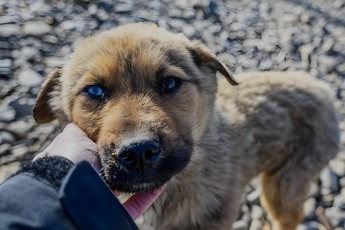
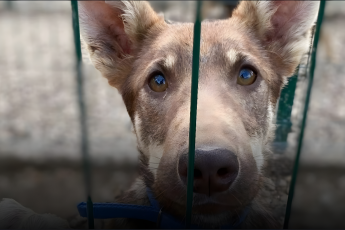
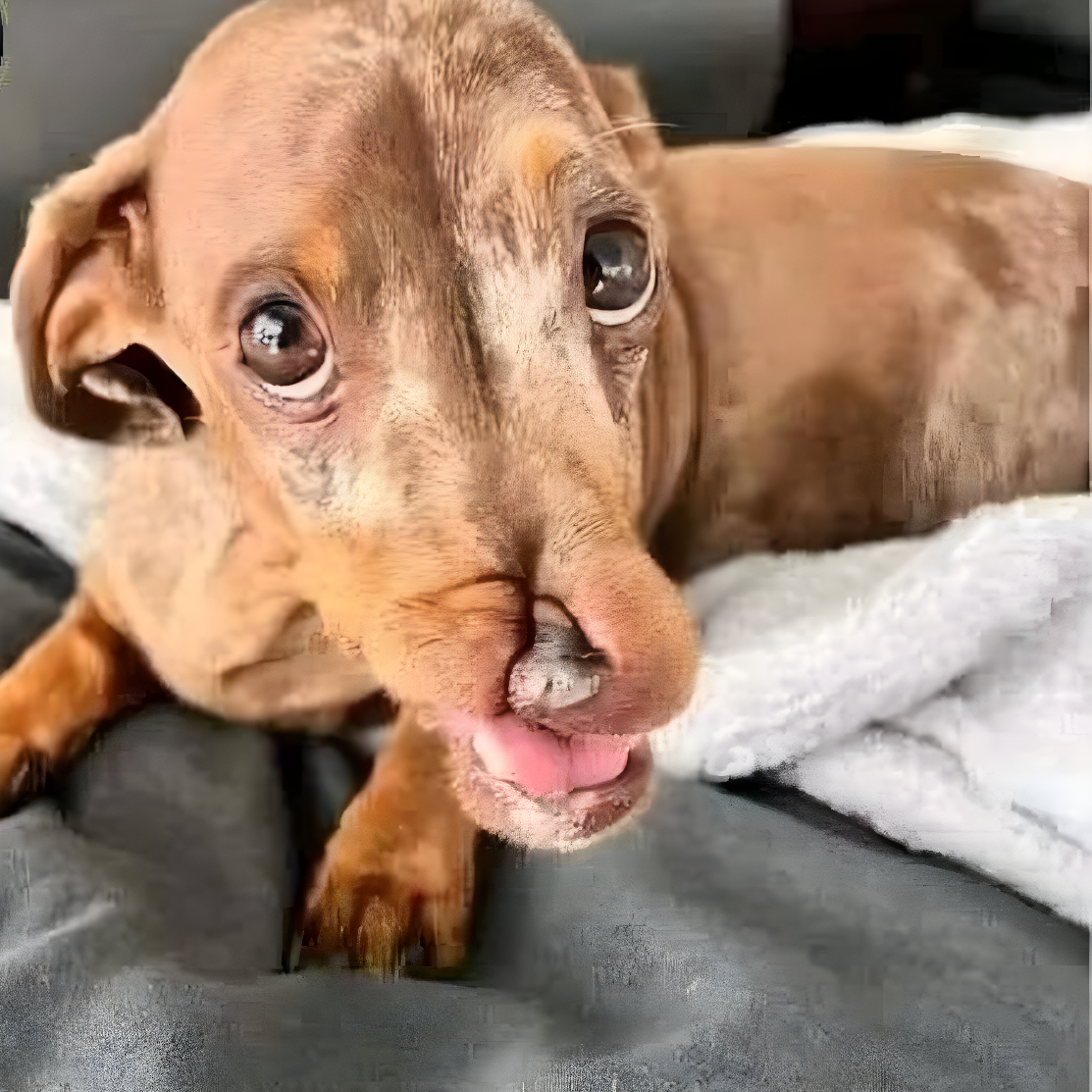
 I first noticed her under the rusty bench at the bus terminal — the spot that always smelled of diesel, damp cardboard and the bakery’s warm bread. Her coat looked as though someone had blended cocoa with a late–summer tan. The features of her face were off-kilter: a nose nudged half a centimetre aside, a lip parted to reveal a narrow, vulnerable seam, and a tongue that slipped out more from awkwardness than arrogance. Passersby averted their gaze. I crouched, set my palm on the cold asphalt and waited for her to decide. She came forward, placed her head in my hand and exhaled as if remembering that being near a human could mean safety.
She didn’t beg. She simply trusted.
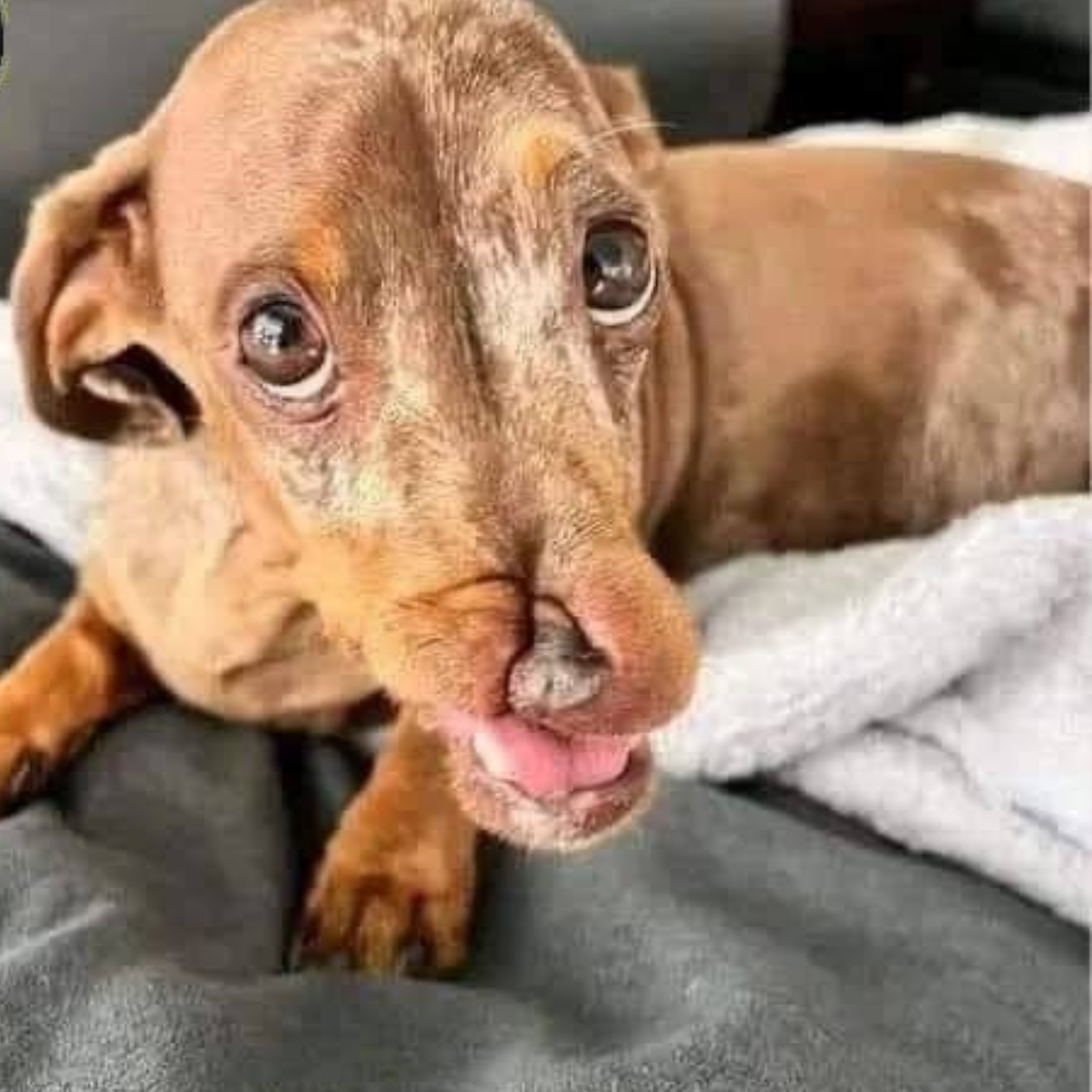
I work as a paramedic and I don’t promise miracles lightly, but that night I leaned close and whispered, “We’re going home, little one.” In the car she did not demand affection or try to earn her place; she curled against my jacket, and in that quiet surrender I stopped rationing my attention between calls and the weight of other people’s tragedies.
“This is a congenital cleft,” the veterinarian said after a quick, then professional, inspection. “It’s a life she can live, but you will need to feed carefully, protect her from colds and teach her how to drink without aspirating.”
Dr. Likhachyov’s tone was not clinical coldness but the plain care of someone who sees sleeplessness in a stranger and speaks gently. He added, “Dogs like her often have hearts that go on working harder than expected, because they must constantly prove they are not less.” I nodded; the news slid into a hollow I knew well — that familiar ache when fragile things appear where strength was meant to be.
At home I laid out a wool blanket, soaked kibble until it softened and set a mug of warm water for careful sipping. Her name came as she lapped the water and seemed to smile at her own reflection: Button. The name felt small and stubborn, a stitch of kindness that might hold life’s jacket closed.
Early days were a mixture of learning and tenderness. I practiced tilting bowls, blotting drooly corners to prevent irritation, and not laughing when her tongue slipped free in sudden joy. People watched us on the street in varying degrees of curiosity and discomfort. Some smiled; others looked away. Button walked beside me without shame, and I realized I had been living in a perpetual sprint — saving, explaining, returning to the next night’s tension — and I hadn’t noticed how tired I’d become.
- New routines: angled bowls and gentle wipes
- Social reactions: avoidance, questions, surprise
- Internal shifts: a paramedic learning to come home
When I told my mother about Button, she worried in that long, careful way people reserve for the most important things: duties, fatigue, fear that I might run out of myself. I answered honestly: I needed someone who would anchor me at home, someone whose breathing would remind me I belonged there too. My mother arrived clutching chicken and kefir, and Button lay down beside her feet like a small, defiant peace offering. My mother stopped speaking of burdens and started asking what sweater would suit her new companion.
“You have invisible seams too,” I told Button one night, speaking aloud after a shift, the kind of confession I hadn’t made in a long time. “I run from call to call until silence disappears, and I’m afraid I’ll fail to arrive when it matters. Maybe you’ll teach me how to come back.”
That conversation changed the quiet of the apartment. Button sighed as if relieved and I slept without nightmares for the first time in months.
A month later, Dr. Likhachyov called with a referral — a veterinary surgeon who specialized in complex facial work. He warned me about risks and promised no false hope: sometimes a small correction reduces chronic irritation and makes daily life significantly easier. I liked the slow honesty; it felt like an offered cup of hot water rather than a sold miracle.
The surgeon examined Button with unusually gentle hands. When he looked at my face he asked, casually, if I’d had surgery as a child. The question surprised me and pulled something quiet free. It turned out my own history had a similar faint trace; my mother had kept it private. The surgeon suggested a minor stitch to strengthen the lip edge and reduce inflammation long-term. He also said it might help me start conversations I had been avoiding.
He spoke plainly: “The operation won’t erase her uniqueness. It will make her life easier.”
- Medical truth: small interventions can create big relief
- Emotional truth: silence within families can haunt as much as scars
I called my mother and asked for honesty. Her answer was a quiet unburdening: she had been ashamed and protective, had wrapped my small face with hats and asked me not to smile too widely. She admitted that fear had kept her from giving me the freedom to laugh openly. I walked through wet snow and let the tears come, and Button trotted beside me, sniffing my fingers as if to say it was all right to feel.
“Sometimes the right turn in life is simply truth spoken late,” I thought, and believed it then.
Surgery took place in early spring. My tension stretched thin waiting for the call that everything was over. The surgeon reported back: they reinforced the nasal wing, adjusted the lip edge and expected easier breathing and fewer irritations. He promised Button would keep her signature half‑smile — it was part of who she was — but its work would be less painful.
Button came home sleepy and smelling faintly of the clinic’s antiseptic and something sweet kept on the operating table for comfort. A week later I brought her to the paediatric clinic lobby where I sometimes lead sessions for parents of children with special needs. An eight‑year‑old boy in a striped hat — Yegor — approached us, stared at Button and then at me with the solemnity of someone diagnosing life. He took off his hat later to reveal a neat scar beneath his lip. He told me, bravely and then quietly, that seeing Button had made him feel less alone.
That afternoon taught everyone who was watching a simple lesson: the presence of one small, unembarrassed creature can change how people see themselves.
- Yegor: found courage to show his scar
- His mother: stopped hiding her own worry
- Button: offered a living example that differences don’t erase worth
Weeks passed. Yegor returned sometimes to show other children his scar and tell them how meeting Button helped him be lighter about his face. My mother began knitting outrageously long, cozy scarves for Button, each loop embroidered with something like apology and pride. Dr. Likhachyov one evening brought a copy of my old hospital record — a piece of paper that made my family story tangible. He said sometimes the patient you treat isn’t the one who came through the door but the person who stands beside them and cannot speak where it hurts.
“Healing can ripple,” he said. “One correction, one brave animal, one small truth can loosen silence in a family.”
We did not reach a dramatic finale. Life resumed its quiet work: I still run morning shifts, I still return to a warm nose pressing into my thigh, and Button still walks with a half‑smile that holds everything she is. Yegor shows children his scar and tells them that being different does not mean being less. My mother sits at the kitchen table and tells stories about my childhood more often, and each time she touches my face it feels less like she is guarding a wound and more like she is celebrating the laugh lines.
In short:
- A chance encounter at a bus stop became a bond that changed an exhausted paramedic’s life.
- Small veterinary intervention eased a daily hardship without erasing identity.
- One dog’s calm presence helped a child and his mother to lift their heads into daylight.
For me the key discovery was this: a true smile does not have to be symmetrical to be courageous. Courage is not the absence of fear; it’s the act of moving forward because someone or something matters enough to keep you present. Button walks at my side. Her smile is half‑formed, but her heart is whole — and in that wholeness she teaches everyone around her to look, to stay, and to care.
Conclusion. A small, imperfect animal became a catalyst for honesty, repair and renewed connection. Practical care and a modest surgical correction improved daily comfort, but the deeper healing came from companionship: from a hand placed on a head, a mother’s late confession, and a boy who found the courage to show his face. We continue — ordinary, messy, brave — and Button’s half‑smile reminds us that wholeness often grows where someone refuses to look away.
Image credits: retained original images as they appeared in the story.